
Fly Fishing Guide Marketing: What Actually Works
Most fishing guides don't need more marketing tactics. They need the right ones, in the right order.
Fishing guide marketing comes down to four things: looking professional, getting found online, building trust through content, and only then investing in advertising. The guides who build in that sequence stay booked. The ones who skip steps stay stuck on the word-of-mouth roller coaster.
This is one of the most common conversations we have. A guide calls and says, "I think I need to run ads." Usually, what they actually need comes well before that.
Here's what fishing guide marketing looks like when it's built to last.
What Is Fly Fishing Guide Marketing?
Fly fishing guide marketing is the work of getting found by anglers who are ready to book, and giving them enough confidence to reach out. In practice it comes down to four things: a professional website, showing up in search, publishing content that proves you know the water, and — only after those are working — paid advertising.
It's different from general small-business marketing in three ways. The season is short, so timing matters more than volume. The purchase is high-consideration, because someone is spending several hundred dollars and a day of their life on a stranger. And the audience is small and specific, which means broad tactics waste money that targeted ones wouldn't.
The rest of this guide walks through what to do, in what order, and what it costs.
Why Isn't Word of Mouth Enough Anymore?
Word of mouth is great. It's how most guides get started, and it never stops mattering. But it has a ceiling.
Referrals come in waves. You can't control the timing, and you can't scale them. One person telling one person works until it doesn't fill your calendar consistently.
The bigger problem is what happens after the referral. Someone hears your name and does what everyone does: they Google you. If your website, reviews, and social media don't match the recommendation they just heard, you've lost them before they ever reached out.
Word of mouth gets your name in the room. Your online presence is what closes the deal.
Where Should a Fly Fishing Guide Start?
Start with your website. Then get found. Then build trust. Then — and only then — pay for traffic.
This is where most marketing advice falls apart. You'll find articles listing ten tactics (Google Ads, Instagram, email, SEO, YouTube) and every one is technically correct. But none of them tell you where to start.
Good Drift uses a four-layer framework with fly fishing businesses. The idea is simple: don't invest in the next layer until the one beneath it is solid.
Layer 1: Professional Presence.
Your website, your branding, your photography. If your site looks like it was built in 2014, nothing else you do will work as well as it should. Your website needs to load fast, look sharp on a phone, clearly explain what you offer, and make it easy to book or reach out. It's the hub everything else points back to.
Layer 2: Being Found.
This is SEO and Google Business Profile. When someone searches "fly fishing guide [your river]," you need to show up. And it's not just Google anymore. More people are asking AI assistants like ChatGPT and Perplexity for recommendations. If your website doesn't answer the questions anglers are asking, you're invisible in both traditional and AI search.
Layer 3: Building Trust.
Content marketing. Blog posts, fishing reports, email newsletters, social media. This is where you demonstrate expertise and build relationships before someone ever books a trip. A guide who publishes a weekly fishing report isn't just sharing information. They're proving they know the water, they're actively guiding, and they care enough to show up consistently.
Layer 4: Driving Growth.
Paid advertising, campaigns, and strategic partnerships. This is where Google Ads and Meta Ads live. They work, but only when the first three layers are doing their job. Running ads to a bad website is like chumming the water with no hook in it.
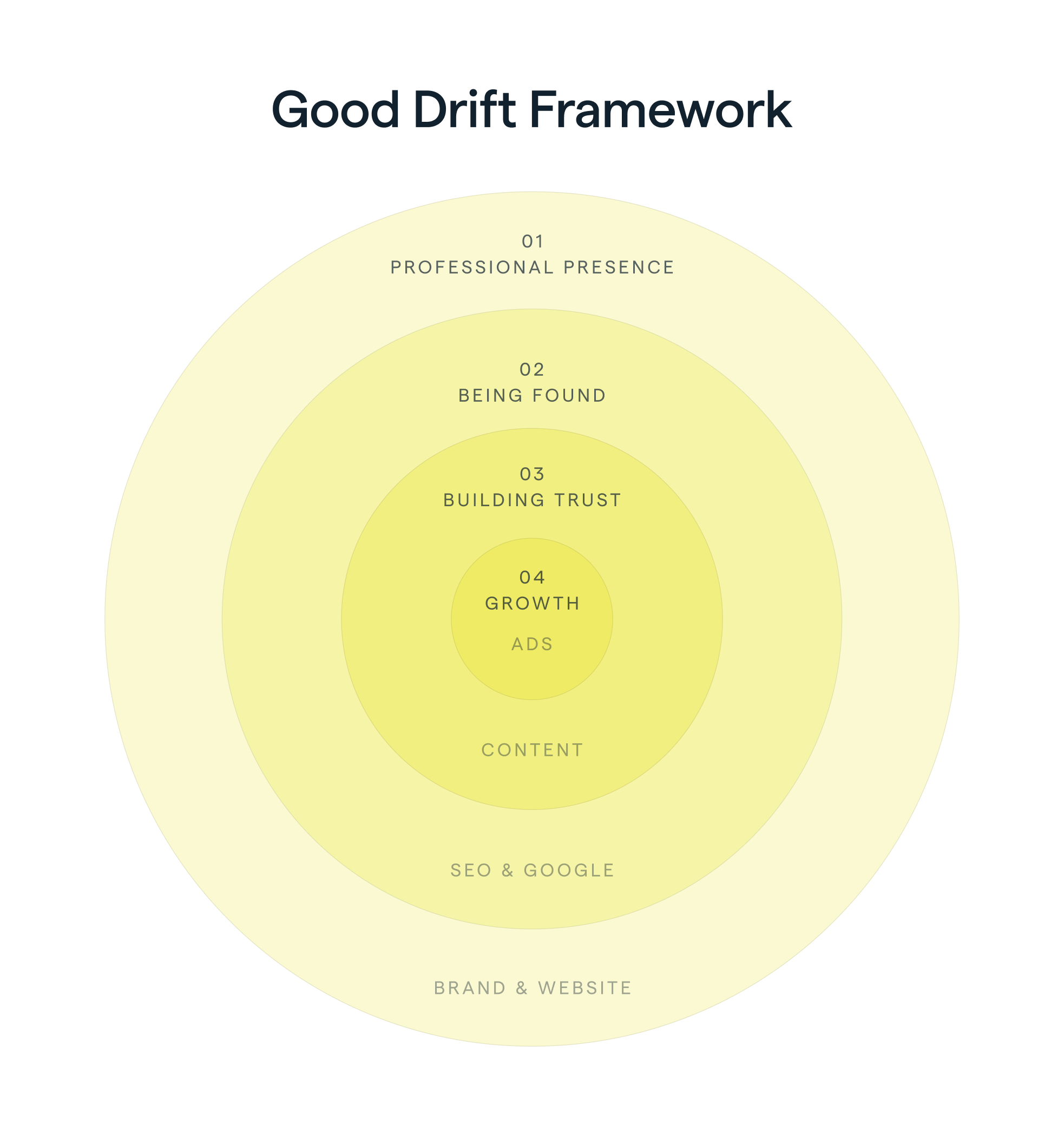
Most agencies lead with Layer 4 because that's where they make money. Good Drift starts at Layer 1 and builds up, because that's what actually works.
How Do Fly Fishing Guides Get More Bookings?
Fly fishing guides get more bookings by fixing the path a potential client already walks: they hear your name, they search you, they land on your site, and they either book or leave. Most guides lose people at step three.
Not every channel matters equally. Here's where to focus, roughly in priority order.
Your website. The one non-negotiable. It doesn't need to be fancy, but it needs to be fast, mobile-friendly, and clear. Include your target species, your waters, trip pricing, booking info, photos from real trips, and a way to contact you. Most guide websites are missing at least two of those.
Google Business Profile. Free and wildly underused. A complete, active GBP listing with recent photos and reviews puts you on the map. Literally. When someone searches "fly fishing guide near me," GBP is often the first thing they see. Update it regularly. Ask every client to leave a review.
SEO and content. Write about what you know. Fishing reports, hatch charts, gear recommendations, trip planning guides for your specific water. Every piece of content is another chance to show up when someone searches for information about your fishery. A guide with 30 blog posts answering real questions about their river has a massive advantage over one with a static five-page website.
Email marketing. Build a list. A seasonal newsletter, trip availability updates, fishing reports. It doesn't need to be complicated. Email is the one channel you own outright. Social media algorithms can change overnight. Your email list can't be taken away.
Social media. Post catches, conditions, behind-the-scenes moments. Be consistent, but don't overthink it. Social media for guides is less about going viral and more about staying visible to people who already know you exist.
Paid advertising. Google Ads can fill gaps in your calendar, especially for seasonal pushes or destination anglers. But it belongs last in the sequence, not first.
Does SEO Work for Fly Fishing Guides?
Yes — and it works better for guides than for most small businesses, because the competition is thin and the search intent is unusually clear. Someone typing "fly fishing guide Madison River" is not browsing. They are close to booking.
The catch is that it's slow. Expect three to six months before you see meaningful movement, and closer to a year before search becomes a reliable booking source. That timeline is why SEO belongs in your off-season. Build it in December so it pays in June.
What actually moves the needle for a guide:
Water-specific pages. One page per river, tailwater, or fishery you guide. "Fly fishing the Green River" will outrank a generic services page every time.
Species and technique pages. Trout, steelhead, carp, streamer fishing, dry fly instruction — whatever you actually specialize in.
Fishing reports. The single most underrated tactic. They're fast to write, they signal you're on the water right now, and they accumulate into a library of river-specific content nobody else has.
Trip planning content. When to come, what to bring, what a day looks like, what the drive is like. This is what out-of-state anglers search before they search for a guide.
What doesn't: keyword stuffing, buying links, publishing thin posts on a schedule just to publish. Google got good at spotting all three.
A guide with 30 posts answering real questions about their fishery has a structural advantage over one with a five-page static site. Not because of volume — because there are 30 different searches that can find them.
One thing that's changed: anglers increasingly ask ChatGPT and Perplexity for guide recommendations. Those systems cite pages that answer questions directly and clearly. Which means the work that helps you in Google is the same work that gets you mentioned in AI answers. You don't need a separate strategy. You need clear answers to real questions.
What Should a Fly Fishing Guide Budget for Marketing?
A working guide should plan on 5–10% of gross revenue annually. A guide grossing $80,000 is looking at $4,000–8,000 a year — most of it front-loaded into a website, then a smaller ongoing spend.
Here's roughly what things cost:
Website build — $2,000 to $6,000, one time. Squarespace on the low end, custom build on the high end.
Domain and hosting — $150 to $400 a year. Non-negotiable.
Trip photography — $500 to $1,500. One good day of shooting lasts years.
Google Business Profile — free. The highest-ROI item on this list.
Booking software — $0 to $150 a month. Some platforms take a percentage of the booking instead.
Email platform — $0 to $50 a month. Free under roughly 500 contacts.
Google Ads — $300 to $1,000 a month. Only during seasonal pushes.
Agency retainer — $1,000 to $3,000 a month. A realistic range for guide-scale work.
Where the first dollar should go. If you have $500 total, spend it on photography and put the rest into your Google Business Profile — which costs nothing but time. If you have $5,000, build the website properly. Everything else can wait.
Where guides waste money. Ads pointed at a website that can't convert. Logo redesigns before there's a working booking flow. Paying someone to post on Instagram three times a week while the Google Business Profile sits half-empty.
A note on seasonality. Don't spread spend evenly across twelve months. Build in the off-season, advertise in the six to eight weeks before your season opens, then pull back. Guides who run ads year-round are usually just funding Google's Q1.
What Do Most Fly Fishing Guides Get Wrong?
Search for "fishing guide marketing" and you'll find the same advice recycled across a dozen agency websites. Most of it isn't wrong. It's just incomplete.
The biggest mistake is treating marketing like a list of disconnected tactics. "Do SEO. Run ads. Post on Instagram. Get reviews." That's a checklist, not a strategy. Without prioritization, guides end up spending money on ads before their website can convert the traffic, or posting on social media while their Google Business Profile sits empty.
The second mistake is generic advice dressed up in fishing language. Most content ranking for this topic is written by agencies that serve dozens of industries. They swap "restaurant" for "fishing charter" and call it specialized. A fly fishing guide in Montana has different marketing needs than an offshore charter captain in the Florida Keys. The seasonality, clients, price points, and content strategy should all be different.
The third mistake is ignoring AI search entirely. More potential clients are asking AI assistants for trip recommendations and guide suggestions. If your business isn't showing up in those answers, you're missing a growing channel. The fix is the same thing that helps with traditional SEO: publish clear, specific, genuinely helpful content that answers real questions.
When Should a Fly Fishing Guide Hire an Agency?
Most guides shouldn't — at least not yet. If your website is solid, your Google Business Profile is complete, and you're publishing occasionally, you're already ahead of most of your competition. Keep doing that.
It's probably time to bring someone in when:
You're consistently booked but want to raise rates rather than add days, which means attracting a different client
You're running a lodge or outfitter with multiple guides and the marketing has become someone's neglected third job
You've built the foundation and genuinely can't find the hours to maintain it during season
You're expanding to a new water or a new trip type and need to build demand from zero
It's probably not time when: you just want more bookings and haven't fixed your website yet. An agency can't out-market a booking page that doesn't work.
Good Drift works exclusively with fly fishing businesses — guides, fly shops, lodges, brands, and conservation nonprofits. No restaurants, no dentists, no "outdoor industry broadly." We understand the seasons, the customers, and the terminology because we're part of the fly fishing community, not just marketing to it.
If you want help figuring out where to start or what to fix first, reach out. We'll tell you what you actually need, even if the answer is "not much."
